Why Do Clocks Have Brass Gears?
Brass gears are often used in clocks where they work well without any lubricant . Oil causes dust to adhere to the gears and this causes gear-tooth wear . An advantage of brass gears is that constant meshing work hardens their teeth. Because of this, the brass gears in well used old clocks often show little sign of wear.
Worm and Wormwheel
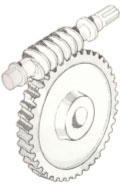
A gear which has one tooth
is called a worm . The tooth is in the
form of a screw thread. A wormwheel meshes with
the worm. The wormwheel is a helical gear with
teeth inclined so that they can engage
with the thread-like worm. The wormwheel transmits torque and rotary motion
through a right angle . The worm always
drives the wormwheel and never the other way round.
Rack and Pinion
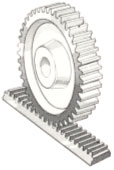
A rack and pinion mechanism is used to transform rotary motion into linear motion and vice versa. A round spur gear, the pinion, meshes with a spur gear which has teeth set in a straight line, the rack.
Internal Gear
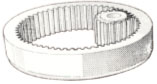
Internal
gears have better load-carrying capacity than external spur gears. They are safer in use because the teeth are guarded.
Worm mechanisms are very quiet running.
|