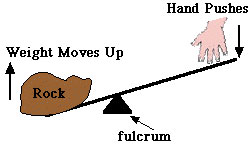
To understand the gear you first have to understand the lever. The lever and fulcrum make up a simple machine where a stiff beam (the lever) rotates about a fixed pivot (the fulcrum).
 The
principle of the lever has been used since before written
language. Levers were initially invented so that heavy
stone blocks could be moved using only muscle power.
Levers still form the operating principle behind many
common machines, both powered and hand operated. A practical
lever includes the lever itself and the fulcrum. To work
properly, the fulcrum is usually fixed in place relative
to the lever.
The
principle of the lever has been used since before written
language. Levers were initially invented so that heavy
stone blocks could be moved using only muscle power.
Levers still form the operating principle behind many
common machines, both powered and hand operated. A practical
lever includes the lever itself and the fulcrum. To work
properly, the fulcrum is usually fixed in place relative
to the lever.
Like other simple machines, the lever is best understood through the concepts of input and output forces. The diagram above shows a lever. The hand pushing down on the lever is the input force. When the hand pushes down the rock will rise up. This is the output force. The output force can be larger or smaller than the input force, depending on the length of the lever and where you place the fulcrum.

The diagram to the right shows a little longer lever. You will notice side "A" is equal to side "B". Or the input force equals the output force. But notice that side "B" is longer than side "A". Therefore the output force will be larger. This is a ratio of output force to input force called mechanical advantage.
This is why we can change a tire on a car by ourself. With very little input force we can raise the car to change the tire. (output force.)